Author Archives: admin

A Tiny RNA That Copies Itself

Journal: RNA Science in Focus (RSiF)
Publisher: Malaysian Society of RNA Science (PPM-031-07-15012024)
Citation: RNA Sci. Focus 2026; 1(1): Article e2
Publication Date: October 28, 2026 | Section: Research Highlight
Issue: Volume 1, Issue 1 (Inaugural Issue)

Overview

How did life begin? The RNA World hypothesis proposes that, before DNA and proteins, RNA did everything: it stored genetic information and catalysed its own copying. But there has always been a catch. The RNA enzymes (ribozymes) known to copy RNA were large and complex—often more than 150 nucleotides long. Molecules that big are unlikely to have arisen by chance on the early Earth, and are too complex to copy themselves.

Discovery of the QT45 Ribozyme

A team led by Philipp Holliger at the MRC Laboratory of Molecular Biology in Cambridge has now challenged that assumption. Rather than refining existing ribozymes, they searched vast pools of random RNA sequences—about 6 × 10¹² unique sequences—for any that could copy RNA. After 11 rounds of selection, they identified three small RNA motifs with polymerase activity. Further directed evolution and truncation yielded QT45, a ribozyme just 45 nucleotides long.

Mechanism & Synthesis Yields

Despite its small size, QT45 can copy RNA templates using trinucleotide triphosphate (triplet) building blocks in mildly alkaline eutectic ice. Crucially, it can synthesize both its complementary strand—using a random triplet pool at 94.1% per-nucleotide fidelity—and a copy of itself using defined substrates. Both reactions yielded approximately 0.2% product over 72 days.

Implications for RNA Science

The system is not yet self-sustaining. Copying is slow and yields are low, so a continuous cycle of replication remains to be demonstrated. But the finding changes the odds: the discovery of polymerase activity in such a small RNA motif suggests that polymerase ribozymes are more abundant in RNA sequence space than previously thought.

For RNA scientists, QT45 is also a reminder that functional RNA may be hiding in sequence space we have barely explored.


Primary Reference

1. Gianni E, et al. A small polymerase ribozyme that can synthesize itself and its complementary strand. Science. 2026;391(6789):1022–1028. doi:10.1126/science.adt2760
Welcome to RNA Science in Focus: Launching the Micro Journal of the Malaysian Society of RNA Science

Journal: RNA Science in Focus (RSiF)
Publisher: Malaysian Society of RNA Science (PERSATUAN SAINS ASID RIBONUKLEIK MALAYSIA | Reg: PPM-031-07-15012024)
Citation: RNA Sci. Focus 2026; 1(1): e1
Publication Date: October 2026 | Section: Editorial
Issue: Volume 1, Issue 1 (Inaugural Issue)

Welcome to the inaugural issue of RNA Science in Focus (RSiF), the official micro journal and concise publishing platform of the Malaysian Society of RNA Science (MSRS).

A Platform for Regional RNA Science

From non-coding RNAs and RNA modifications to epitranscriptomics, RNA therapeutics, and vaccines, RNA science is rapidly redefining our fundamental understanding of biology and transforming how we treat human disease. RNA Science in Focus was established to provide a dedicated space for short, accessible, and timely scientific writing on these breakthroughs.

Our core mission is to keep our members and the wider scientific community informed, foster interdisciplinary collaboration, and prominently highlight RNA research, laboratories, and achievements within Malaysia and the surrounding region.


What We Publish

RSiF publishes concise, impactful contributions (typically 500–1,000 words) across four distinct categories:

  • Research Highlights: Short summaries and contextual analysis of notable recent peer-reviewed studies in RNA science.
  • Commentary: Expert opinion and perspectives on new technological developments, emerging research, controversies, and future directions.
  • Local Spotlight: Features highlighting RNA research, laboratories, collaborative networks, and scientific milestones in Malaysia and the region.
  • Updates: Timely news regarding Society activities, regional conferences, hands-on workshops, funding opportunities, and training programs.

Contribute to RSiF

We warmly invite contributions from Society members and the broader scientific community, including established investigators, industry professionals, post-doctoral fellows, and early-career postgraduate/undergraduate students. Articles should be written in clear, accessible language suitable for a broad scientific audience.

To propose an article or discuss potential submissions, please email the editorial team at webmaster@myrnascience.com.


Editorial Governance & Board

Editor-in-Chief:
A/Prof. Dr. Ch’ng Ewe Seng (Vice Chair, MSRS)

Editorial Board (MSRS Executive Committee 2025–2027):
Prof. Dr. Tang Thean Hock (Chair)
Dr. Siti Aminah Bt. Ahmed (Secretary)
Dr. Anna Andrew (Assistant Secretary)
Dr. Ang Kai Cheen (Treasurer)
A/Prof. Dr. Wang Seok Mui (Committee Member)
Dr. Robaiza Zakaria (Committee Member)

Disclaimer: Views expressed in RNA Science in Focus are those of the individual author(s) and do not necessarily reflect the official positions or policies of the Malaysian Society of RNA Science.

MSRS Co-Organises International Academic Talk on South–South Scientific Cooperation with INFORMM USM

The Malaysian Society of RNA Science (MSRS) was proud to co-organise an international academic talk with the Institute for Research in Molecular Medicine (INFORMM), Universiti Sains Malaysia (USM). The talk was titled “South–South Scientific Cooperation: Reshaping the Geopolitics of Knowledge and Biomedical Innovation.” It was held in hybrid format at INFORMM Conference Room 1 and via Webex.

MSRS was honoured to welcome the speaker, Professor Odir Antonio Dellagostin of the Federal University of Pelotas (UFPel), Brazil, who is also President of the Research Support Foundation of Rio Grande do Sul (FAPERGS). The Society thanks Associate Professor Ts. Dr. Aziah Ismail, Director of INFORMM, and Dr. Eugene Ong Boon Beng, Deputy Director (Postgraduate and International), for their warm hospitality. MSRS was represented by its Founding Chair, Dr. Tang Thean Hock.

In his talk, Professor Dellagostin described how the global landscape of scientific research is shifting, with Asian countries and emerging economies contributing a growing share. According to data he presented, China has overtaken the United States in annual scientific publication output, and Malaysia’s scholarly output rose by 39.8% between 2021 and 2025.

He called for stronger South–South scientific cooperation through:

  • joint research funding
  • researcher mobility
  • shared scientific infrastructure
  • strategic international partnerships

The discussion also explored collaboration opportunities in biomedical research, vaccine development, molecular diagnostics and biotechnology. These areas closely match MSRS’s mission to advance RNA science in Malaysia.

MSRS thanks Professor Dellagostin for an inspiring session, INFORMM for being an excellent partner, and all participants who joined in person and online. The Society looks forward to building on this exchange and fostering international partnerships, knowledge sharing and biomedical innovation for the benefit of society.

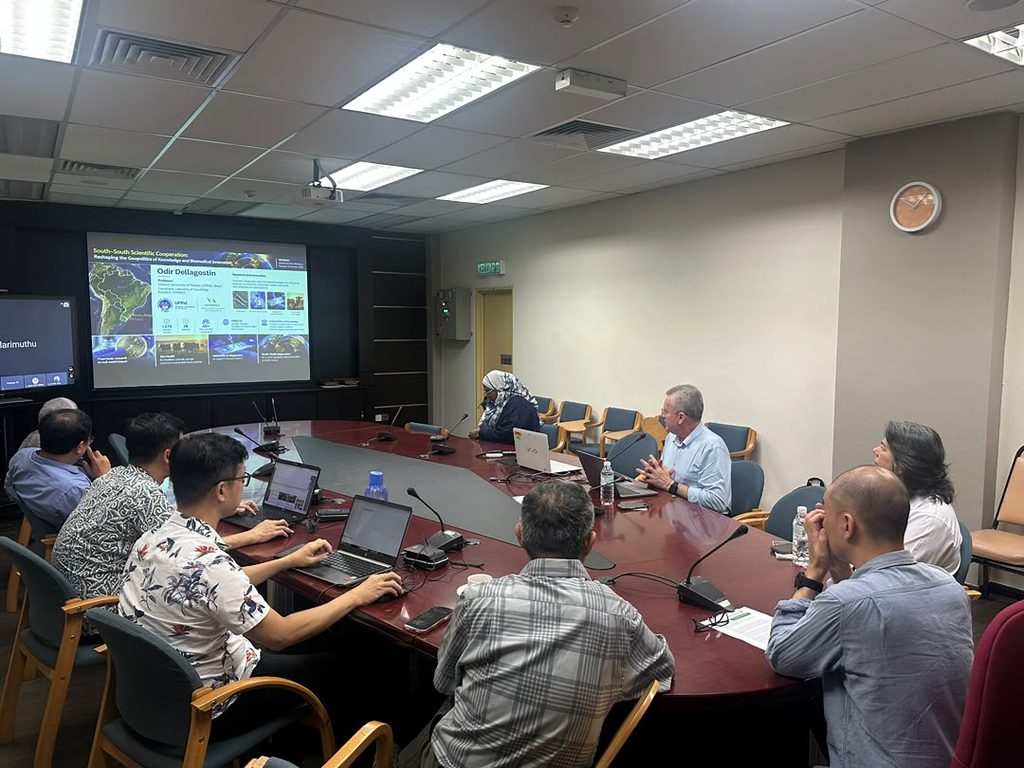
Participants at INFORMM Conference Room 1 during the talk “South–South Scientific Cooperation: Reshaping the Geopolitics of Knowledge and Biomedical Innovation.” The session ran in hybrid format, with online participants joining via Webex.

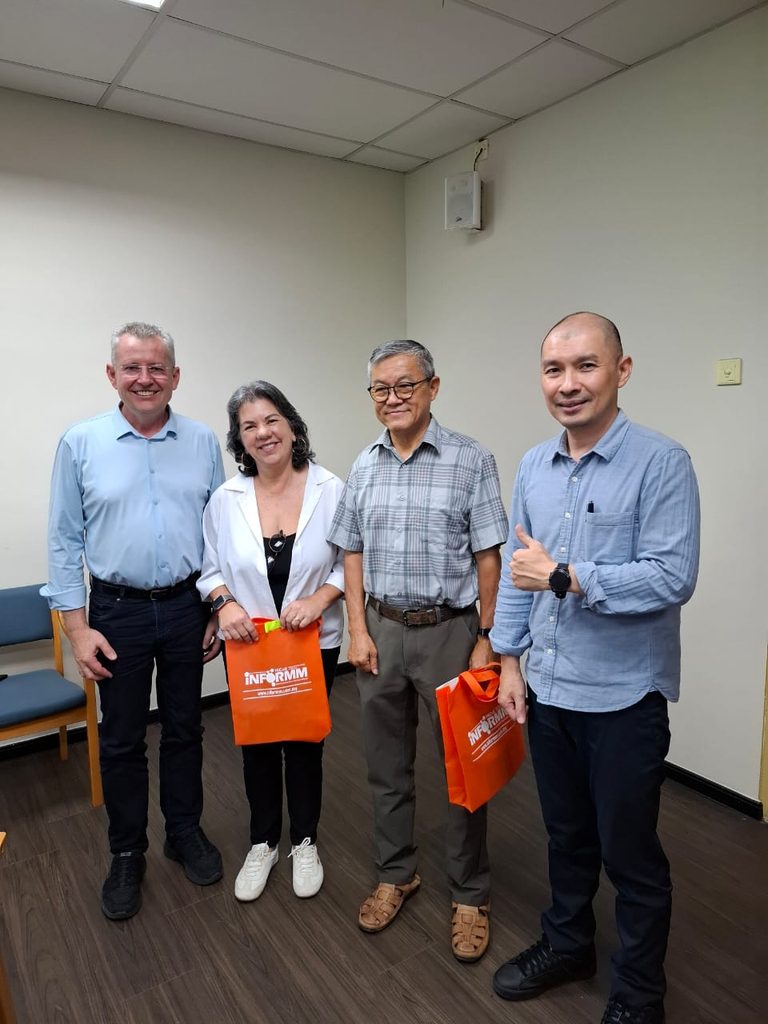
From left: Professor Odir Antonio Dellagostin (UFPel, Brazil) and his wife, Mrs. Diovana Dellagostin; Professor Tang Thean Hock (Founding Chair, MSRS); and Dr. Eugene Ong Boon Beng (Deputy Director, Postgraduate and International, INFORMM), after the international academic talk at INFORMM, Universiti Sains Malaysia, on 30 October 2026.

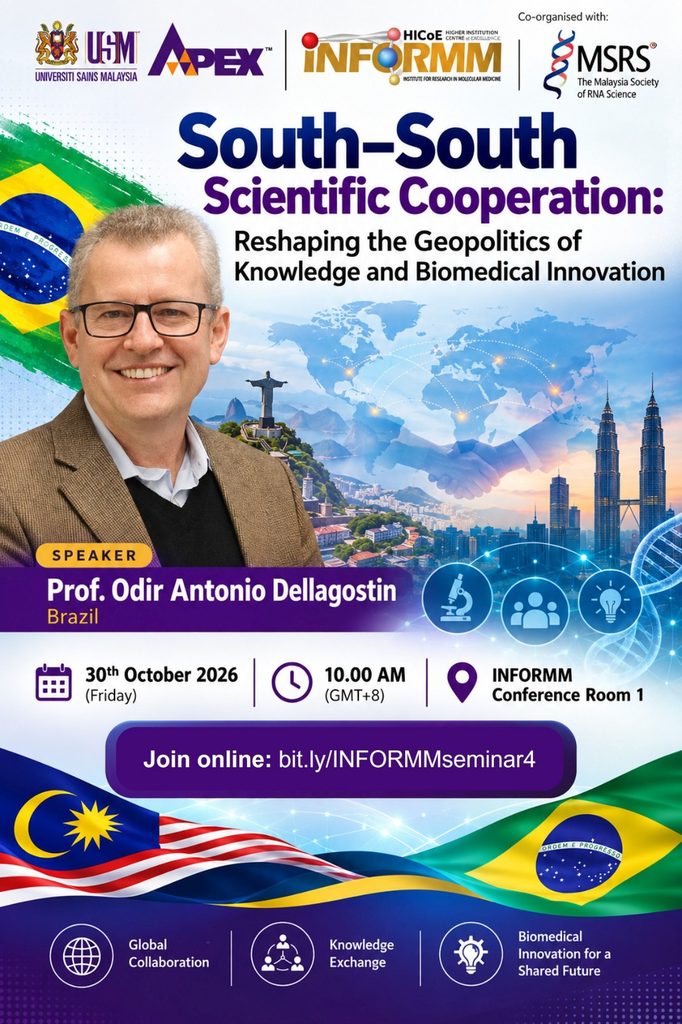
Seminar Announcement: Reshaping the Geopolitics of Knowledge and Biomedical Innovation

Malaysian Society of RNA Science is delighted to co-host the visit of Professor Odir Antônio Dellagostin to Penang!

Together with the Institute for Research in Molecular Medicine (INFORMM), Universiti Sains Malaysia, we warmly invite you to a special seminar:

Reshaping the Geopolitics of Knowledge and Biomedical Innovation

📅 Date: Friday, 30 October 2026
🕙 Time: 10.00 am (MYT)
📍 Venue: INFORMM Conference Room 1, Universiti Sains Malaysia
💻 Online: bit.ly/INFORMMseminar4

About the Speaker
Prof. Odir Dellagostin is a Professor at the Federal University of Pelotas (UFPel), Brazil, and a CNPq Level 1A Research Fellow. He trained as a veterinarian at UFPel and earned his PhD in Molecular Biology at the University of Surrey, UK. His research covers molecular biotechnology and recombinant vaccines, notably against leptospirosis, and he coordinates Brazil’s National Institute of Science and Technology in Veterinary Vaccines. He has led Brazil’s state research foundation FAPERGS and the national council CONFAP. He is a Full Member of the Brazilian Academy of Sciences and a Fellow of The World Academy of Sciences (TWAS).

What to Expect
Prof. Dellagostin will speak both as a bench innovator and as an architect of national science policy. He will examine:

🔹 Decentralising Vaccine Innovation: How home-grown R&D pipelines for neglected zoonotic and tropical diseases challenge the historic North–South monopoly on technology transfer.

🔹 Scientific Sovereignty & Global Health Equity: Practical frameworks for building self-sustaining regional biotechnology ecosystems that can respond to local endemic diseases and future pandemics.

🔹 Redefining Research Geopolitics: Shifting from passive receipt of biomedical patents to collaborative, South-driven intellectual property and cross-border scientific diplomacy.

Researchers, students and anyone interested in biomedical innovation and science policy are welcome to join us in person or online. See you there!